You may have the right skills for a job and still struggle to communicate them through your resume.
The problem is not always your experience. It may be the way your resume is structured, whether your strongest skills are clearly visible, how closely it reflects the job description, or whether your projects show enough evidence of impact.
That is why reviewing only spelling and grammar is not enough.
Before applying, your resume should answer three questions:
Can the resume be read and understood clearly?
Does it show evidence relevant to the target job?
What important skills or project experience are still missing?
A useful AI resume analyzer helps you investigate all three.
You can also paste a job description to check how well your resume matches the role and identify areas for upskilling.
Not sure what is weakening your resume? Check your ATS readiness, keyword strength, project impact and job fit before applying. Analyze My Resume Free
What Does an AI Resume Analyzer Check?
A resume analyzer does more than search for spelling mistakes.
It examines different parts of your resume to help you understand how clearly your experience is being communicated.
The most useful resume reports separate the analysis into areas such as:
Overall resume score
ATS readiness
Formatting and readability
Keyword strength
Skills clarity
Project impact
Resume bullet quality
Job-description match
Missing skills
Recommended next steps
These areas should not be treated as one universal score.
A resume can be well formatted but poorly matched to a particular job. It can contain many relevant keywords but provide little evidence that you have actually used those skills.
That is why you should review each part of the report separately.
Analysis area
What it examines
What you may need to improve
ATS readiness
Structure, section clarity and readable content
Headings, layout and reading order
Formatting
Consistency and readability
Spacing, fonts, columns and alignment
Keyword strength
Visibility of role-relevant terminology
Skills and terminology you genuinely use
Job match
Alignment with a specific job description
Summary, projects and relevant experience
Skills clarity
Whether important skills are easy to find
Skills section and supporting examples
Project impact
Whether projects demonstrate capability
Problem, tools, actions and results
Skill gaps
Requirements not currently supported by evidence
Learning plan and portfolio projects
Bullet quality
Clarity and strength of experience statements
Action, method, scale and outcome
1. ATS Readiness: Can Your Resume Be Read Clearly?
ATS readiness is commonly confused with keyword count.
Keywords are important, but they are only one part of resume readability.
An ATS-readiness review should also examine whether the main parts of your resume can be identified clearly:
Name and contact information
Professional summary
Work experience
Education
Skills
Projects
Certifications
Creative layouts may look attractive but can make important information harder to interpret.
For example, essential skills may be placed inside sidebars, icons, graphics or complex tables. A simpler structure usually makes the resume easier for both software and people to review.
ATS-friendly formatting checklist
Use familiar section headings such as Experience, Education, Skills and Projects
Keep the reading order clear
Use consistent job titles and dates
Avoid unnecessary charts or progress bars
Keep important information as readable text
Use bullet points instead of dense paragraphs
Check that contact information is visible
Use consistent formatting throughout the document
What an ATS score cannot tell you
An ATS score is not a promise that you will receive an interview.
Different companies may use different systems, workflows and hiring criteria. Treat the score as a diagnostic signal showing where your resume may be unclear or weak, not as a final judgment on your career.
The goal is not to chase a perfect number.
The goal is to remove avoidable problems.
2. Job Match: Does Your Resume Fit the Role You Are Applying For?
ATS readiness asks whether your resume is clear.
Job match asks whether it is relevant.
A generic resume may describe your background accurately while still failing to show why you fit one specific role.
Consider a data analyst job asking for:
SQL
Excel
Power BI
Dashboard development
Data cleaning
Business reporting
Stakeholder communication
Your resume may include SQL and Power BI in the skills section. But stronger evidence would show how you used those tools.
Weak example
Worked on a sales dashboard using Power BI.
Stronger example
Built a Power BI sales dashboard using cleaned Excel and SQL data to track monthly revenue, regional performance and product-level trends.
The stronger version is not better simply because it is longer.
It gives context:
What was built
Which tools were used
What data was analyzed
Which business questions were answered
How to improve your job match
Paste the target job description into the resume analyzer.
Review important requirements and repeated terminology.
Check which requirements are already supported by your resume.
Identify skills you possess but have not demonstrated clearly.
Rewrite relevant bullets using truthful evidence.
Remove unrelated information that distracts from the target role.
Important: Never add a skill simply because it appears in a job description. Add only skills you genuinely possess and can explain during an interview.
3. Keyword Strength: Are the Right Skills Visible in Context?
A keyword checker helps you find terminology that may be missing from your resume.
But keyword stuffing is not a reliable strategy.
Writing “Python, SQL, machine learning, Power BI, AWS, Docker and RAG” in a skills section does not prove that you can use them.
Important skills should appear naturally in your:
Work experience
Projects
Technical decisions
Achievements
Certifications
Portfolio links
Keyword without evidence
Skills: SQL, Power BI, Python
Keyword with evidence
Analyzed customer-order data with SQL and Python, then created a Power BI dashboard tracking retention, revenue and regional performance.
The second example makes the skills easier to understand because they are connected to work.
Use this evidence formula
Action + Tool or Method + Problem + Verifiable Outcome
Example:
Built + SQL and Power BI + sales reporting workflow +
dashboard covering monthly revenue and product performance
Do not invent revenue gains, percentages or user numbers.
Technical evidence can also include:
Number of records analyzed
Number of documents processed
Model evaluation result
API response time
Number of dashboard views
Test cases completed
Features deployed
4. Project Impact: Do Your Projects Prove What You Can Build?
Projects are especially important for students, freshers and career switchers.
When professional experience is limited, projects can demonstrate:
Technical skills
Problem-solving
Tool usage
Business understanding
Evaluation
Communication
Deployment
Documentation
A weak project description only names the technology.
Weak project entry
Customer Churn Prediction using Python.
Improved project entry
Developed a customer-churn prediction project using Python and scikit-learn, compared baseline models and documented precision, recall and major model limitations.
A stronger project entry explains the process and evidence without exaggerating business impact.
Your project section should ideally answer:
What problem did you solve?
What tools did you use?
What did you personally build?
How did you evaluate it?
What can someone review or test?
A GitHub link becomes more useful when the repository includes a clear README, setup instructions, screenshots, results and limitations.
Your resume may not need a full rewrite. It may need clearer evidence, better structure or stronger alignment with the role. Check My Resume and Job Match
5. Skill-Gap Analysis: What Should You Learn or Build Next?
A missing keyword and a missing skill are not always the same thing.
There are three possible situations.
Situation 1: You possess the skill, but it is missing from the resume
Action: Add truthful evidence from your work, education or projects.
Situation 2: You understand the skill but have no project evidence
Action: Build a small project that demonstrates practical application.
Situation 3: You do not currently possess the skill
Action: Add it to a prioritized learning roadmap instead of pretending it is already part of your experience.
This is where skill-gap analysis becomes more useful than a simple keyword count.
It helps you decide whether the next action should be:
Rewrite
Reorganize
Build a project
Learn a new skill
Apply for a better-matched role
Example skill-gap roadmap
Gap
Immediate action
Evidence to build
SQL joins
Complete focused practice
Multi-table sales analysis
Power BI
Learn dashboard fundamentals
Interactive business dashboard
Python data cleaning
Practice Pandas workflows
Messy CSV cleaning project
Machine-learning evaluation
Learn appropriate metrics
Model-comparison notebook
RAG
Understand retrieval pipelines
PDF research assistant
API deployment
Learn FastAPI basics
Deployed prediction endpoint
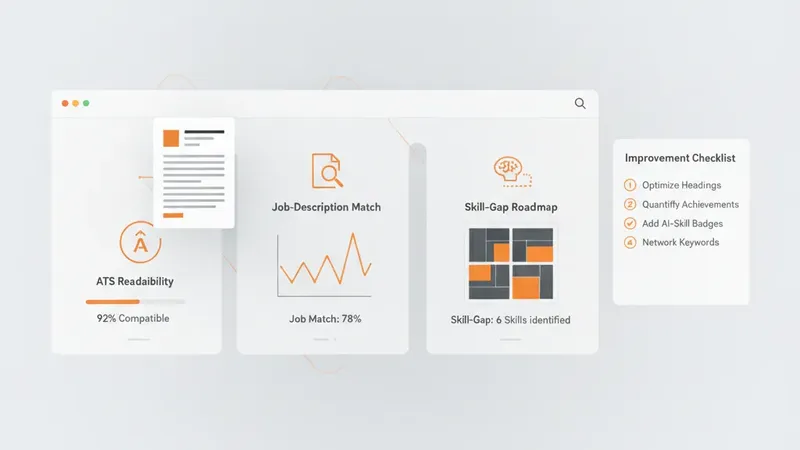
InfraOne’s analyzer is designed to identify missing skills and generate a short roadmap to help users become more job-ready.
What Should You Improve First?
Not every warning deserves equal attention.
Use this priority order.
Priority 1: Readability problems
Fix missing sections, confusing layouts, unreadable text and broken reading order first.
Priority 2: Important job-match gaps
Identify requirements that are essential to the role but not demonstrated in your resume.
Priority 3: Weak experience and project evidence
Improve bullets that list responsibilities or technologies without explaining what you accomplished.
Priority 4: Skill-development gaps
Choose one or two important skills to learn and prove through projects.
Priority 5: Minor wording and visual polish
Refine grammar, repeated words, spacing and consistency after the major issues are resolved.
How to Use the InfraOne AI Resume Analyzer
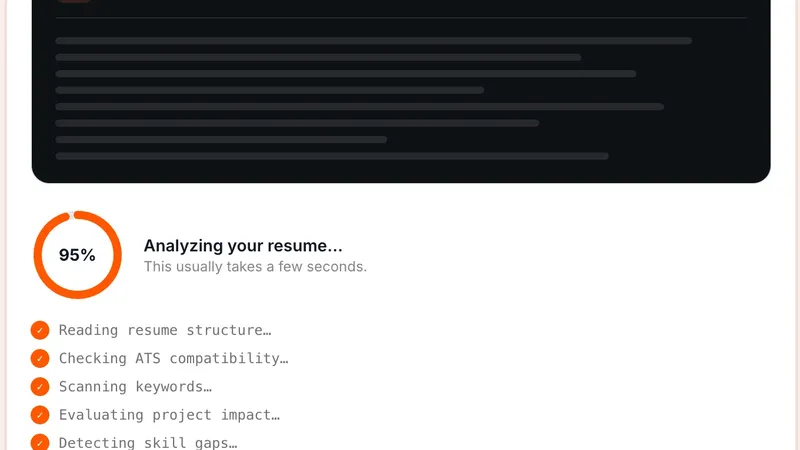
Step 1: Upload your resume
Upload your resume as a PDF, PNG or JPG file of up to 8 MB.
Should I use a highly creative or visually complex resume template to stand out?
While creative layouts might seem appealing, they can make it harder for both automated systems (ATS) and human reviewers to clearly interpret essential information. A simpler, more structured format is generally recommended to ensure readability and clarity of your skills and experience.
What kind of evidence should I include if I don't have direct business results like revenue gains or percentages?
You can use technical evidence to demonstrate impact. This might include the number of records analyzed, documents processed, model evaluation results, API response times, dashboard views, test cases completed, or features deployed.
If I identify a skill gap, is it always best to immediately add that skill to my resume?
No. If you genuinely possess the skill, add truthful evidence. If you understand the skill but lack project evidence, build a small project. If you don't possess the skill, add it to a learning roadmap rather than pretending you have it.
After analyzing my resume, what should be my top priority for making improvements?
Start by fixing readability problems such as missing sections, confusing layouts, unreadable text, or a broken reading order. After that, address important job-match gaps that are essential to the role but not clearly demonstrated.

-400x300.png)

 Rahul Ranjan· 25 Jul 2026· 9 min read
-400x300.png)